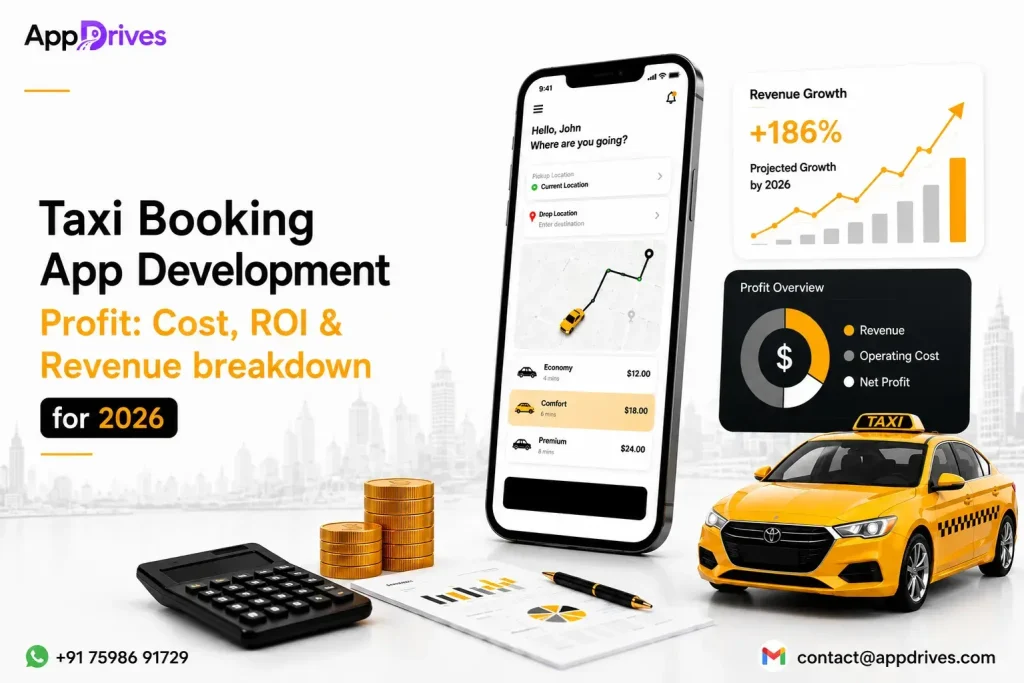
Nowadays, the taxi booking industry has transformed urban transportation by making mobility faster and smarter. Businesses entering the taxi app market now integrate AI analytics, digital payments, and hyperlocal services to maximize taxi booking app development profit. The ride-hailing market is growing rapidly due to urbanization, digital transformation, and people opting for instant booking and departure services. According to the IMARC data, the global taxi market reached USD 255.4 billion in 2025 and is projected to reach USD 383.1 billion by 2034 at a CAGR of 4.47%. This market size and growth are due to the demand for comfortable and efficient means of transport.
Besides the rise in the utilization of smartphones and on-demand transportation habits, taxi booking apps continue to attract enterprises and startup investors worldwide.
In this blog, let’s delve into the profitable taxi booking app development, market forecast, business models, and cost estimation.
Is Taxi Booking App Development Profitable in 2026?
Taxi booking app development is highly profitable in 2026 because consumers rely actively on on-demand mobility solutions. These apps follow a multi-channel revenue model and income comes from ride commissions, fees, ads, subscriptions and premium services. Taxi booking apps like Uber and Lyft show direct revenue with operational efficiency, which leads to long-term growth and profitability.
As the need for mobility increases, new market players have started making considerable investments in taxi booking apps. The smart cities development and preference for app based service providers have opened up opportunities for online taxis. Investors are interested in ride hailing platforms because of their recurring business nature and scalability.
Understanding the Taxi Booking Business Model
The taxi booking business model is built with various tech stacks that connect passengers with drivers in real time. This technology driven approach has made the taxi booking apps one of the fastest-growing and most profitable business models in the modern transportation industry.
Taxi booking apps function via a workflow involving passengers, drivers, dispatch systems and administrators. Customers place ride request and the AI powered dispatch system assigns nearby devices on availability and location. There are various business models in the development of a taxi app.
Aggregator Model vs Fleet Ownership Model:
The aggregator model allows businesses to connect independent drivers with passengers who don’t own vehicles, making it highly scalable and service consistent, but it requires higher investments in vehicle maintenance and staffing.
Peer-to-Peer Taxi Model:
This model enables private vehicle owners to provide ride sharing services via decentralized platforms. This model reduces the infrastructure costs and increases the service availability
Multi-Service Mobility Super Apps:
Many ride hailing companies are evolving into super apps by integrating taxi services with food delivery and other services. This approach increases retention and creates multiple revenue streams.
Essential Features That Improve Taxi App Profitability
The profitable taxi booking app development is based on the features that you integrate. Let’s discuss some of them.
Passenger App Features:
This feature includes ride booking, real-time tracking, ride history and AI powered recommendations. It is used to enhance convenience and improve customer loyalty.
Driver App Features:
Driver apps features provide trip requests, earning dashboards, navigation support, ride analytics and performance monitoring tools to help drivers maximize their efficiency and improve productivity.
Admin Panel Features:
This feature is used to control the fleet management pricing strategies, driver approvals, ride analytics and fraud monitoring systems. It further helps businesses streamline operations and improve profitability.
AI-Powered Features Increasing Revenue:
AI powered dispatch systems optimize driver allocation and reduce passenger wait times. Predictive demand analysis helps businesses to maximize their profits during peak demand periods.
Safety and Security Features:
Safety features such as trip sharing, driver verification and SOS alerts enhances the customer trust and platform credibility. Strong security measures help to reduce disputes and prevent fake bookings.
Taxi Booking App Development Cost
The actual cost depends on the features and complexity.
Imagine that you are launching a taxi app. In phase one, you build a passenger and driver app and an admin panel. Think of a basic ride-hailing application and GPS. This application ranges from $15,000 to $30,000.
As your business grows, you enter phase two of development. At this stage, you need to introduce complex features to your app, such as real-time multi-routing, advanced surge pricing algorithms, and multi-currency payment gateways. These advanced features are responsible for pushing your development costs. At this stage, it might grow from $40,000 to $70,000.
In simple words, it totally depends on how far you expand your platform.
Taxi App Development Cost Breakdown
| Type | Estimated Cost | Estimated Timeline |
| Basic MVP | $15,000–$30,000 | 3–5 months |
| Mid-tier app | $40,000–$70,000 | 5–8 months |
| Advanced platform | $80,000–$150,000+ | 8–12 months |
Taxi Booking App ROI and Revenue Forecast
Taxi booking app can generate you with a steady income for you, supported by a strong market demand. The taxi booking app ROI depends on ride volume, operational efficiency and customer retention rates.
How Long Does It Take to Break Even?
The break even is entirely based on the urban region. Usually, for a startup, it might take one to three years. Faster recovery investment entirely depends on the high ride frequency and customer density.
Below we have provided the answer for your question on how much profit can a taxi app generate
Estimated ROI and Revenue Forecast for Taxi Booking Apps Based on Daily Ride Volume
| Taxi App Type | Estimated Investment | Daily Ride Volume | Monthly Revenue Forecast | Estimated ROI Timeline | Best Suitable Market |
| Small-Scale Taxi App | ₹5L – ₹15L | 100 – 500 rides/day | ₹3L – ₹10L/month | 8 – 15 months | Local city transportation |
| Mid-Size Taxi Platform | ₹15L – ₹50L | 500 – 3,000 rides/day | ₹10L – ₹50L/month | 12 – 24 months | Multi-city operations |
| Enterprise-Level Taxi App | ₹50L – ₹2Cr+ | 3,000 – 20,000+ rides/day | ₹50L – ₹5Cr/month | 18 – 36 months | Large-scale urban & global markets |
Proven Taxi Booking App Monetization Strategies
Instead of depending on ride commission, there are multiple taxi app revenue models to integrate in your platform. Here is the list of taxi app monetization strategies
Commission-Based Revenue Model:
Taxi apps generate revenue by charging drivers a percentage commission on every completed ride. This creates a consistent income with increasing ride volume.
Surge Pricing and Dynamic Fare Optimization:
With the use of AI algorithms, fares are increased during peak hours, bad weather, or high-demand periods. This strategy boosts revenue and pushes more drivers to remain active during busy times.
Subscription and Membership Revenue:
This revenue strategy creates recurring monthly income. Loyalty programs and exclusive benefits improve customer retention and increase predictable revenue streams.
In-App Advertising Revenue:
With local business promotions, sponsored banners and targeted marketing campaigns, taxi app owners can generate advertising revenue. Brands often partner with mobility platforms to reach location-based audiences effectively.
Cancellation Charges and Convenience Fees:
Revenue from cancellation fees and service convenience fees can be overlooked sources of extra revenue for businesses. This is because fees help prevent frivolous cancellations and boost operational efficiency.
Corporate Ride Partnerships:
Transportation agreements for corporate clients guarantee steady sources of income for the taxi industry. It is common for companies to collaborate with ride-sharing services in dealing with transportation needs.
Data Monetization Opportunities:
Ride-hailing services gather transportation data, traffic patterns, and consumer behavior. Data analytics and heat maps generated from such data have potential revenue sources through various partners.
White-Label vs Custom Taxi App Development – Which is More Profitable?
Every business entering the taxi booking industry needs to make a critical decision before launching its platform.
Here it is. Which to choose?
Whether to invest in a ready-made white-label solution or in building a custom taxi app from scratch?
You can choose either one based on your budget and features.
Here, we have provided a short comparison table on white-label vs custom taxi app development
| Factor | White-Label Taxi App | Custom Taxi App |
| Cost | Low | High |
| Launch Time | 1–4 weeks | 4–8 months |
| Customization | Limited | Complete |
| Features | Pre-built | Fully tailored |
| Branding | Custom branding | 100% unique |
| Scalability | Moderate | High |
| Security | Standard | Advanced & customizable |
| Maintenance | Provider-managed | Self-managed or dedicated team |
| Best For | Startups & SMEs | Enterprises & large-scale businesses |
The choice between white-label and custom-made is not just based on the cost, it is about long term profitability, scalability and how far a business plans to grow in the transportation industry.
Advanced Technologies Transforming Taxi App Profitability
The technology stack you choose directly impacts your taxi booking app’s performance, scalability, security, and profitability. A modern taxi booking platform is built using the following technologies:
- Mobile App Development: Flutter, React Native, Native iOS (Swift), Native Android (Kotlin)
- Backend Development: Node.js, Laravel, Python, Java
- Database: PostgreSQL, MongoDB, MySQL, Redis
- Maps & Navigation: Google Maps API, Mapbox, OpenStreetMap
- Real-Time Communication: WebSockets, Firebase Cloud Messaging (FCM)
- Payment Gateway Integration: Stripe, Razorpay, PayPal, UPI
- Cloud Infrastructure: AWS, Google Cloud Platform (GCP), Microsoft Azure
- AI & Machine Learning: AI-powered dispatch, demand forecasting, route optimization, dynamic pricing
- Analytics & Business Intelligence: Google Analytics, Firebase Analytics, Mixpanel
- Security: JWT Authentication, OAuth 2.0, SSL Encryption, Multi-Factor Authentication (MFA), End-to-End Encryption
- DevOps & Deployment: Docker, Kubernetes, CI/CD Pipelines
- Third-Party Integrations: SMS & OTP (Twilio), Push Notifications (Firebase), Email Services, CRM Integration
This technology stack enables businesses to deliver real-time ride booking, seamless payments, intelligent driver allocation, enhanced security, and a scalable infrastructure capable of supporting future growth while maximizing profitability.
Taxi Booking App Profitability Across Different Markets
The taxi booking app profitability across different markets is based on the factors such as location, population, and passenger transportation behaviour.
Profitability in Urban Cities:
Profitability in urban cities is based on population density and high commuting needs of urban cities. Consistent customer demands and large populations make the market profitable.
Opportunities in Tier-2 and Tier-3 Cities:
Opportunities in Tier 2 and Tier 3 cities rises with the increase in usage of smartphones. Localized taxi services often achieve faster customer acquisition in these regions.
Taxi App Demand in Emerging Markets:
Emerging economies show increased demand for affordable transportation via taxi apps. Mobile internet and payment systems have accelerated the taxi platform usage.
Real-World Taxi App Profit Examples
The success of a taxi booking is based on the business model and diversified monetization strategies to generate revenue. Here are some real world taxi app profit examples
- Ola
- Uber
- Grab
- inDrive
- Curb
- Gett
How Uber Generates Billions in Revenue
Uber follows a multu service mobility super apps business model to generate revenue in billions. The company is expanding into logistics and mobility solutions.
Ola, Lyft, and Bolt Profitability Strategies
Ola focuses on regional market dominance and localized pricing strategies. Lyft is mainly based on customer loyalty and partnerships. Bolt competes via lower commission structures and efficient operational models.
Local Taxi Startup Success Stories
Many startup companies achieve profitability by targeting niche markets, offering affordable pricing and focusing on customer service quality.
Challenges That Affect Taxi Booking App Profitability
Though there are various benefits of high income generation in the taxi booking business, companies face challenges that impact profitability.
Driver Retention and Incentive Costs:
Driver retention and incentive costs involves setting up incentives and bonuses. Driver churn can increase the operating cost structure and disrupt service delivery.
Regulatory and Legal Compliance Challenges:
Compliance with tax licenses, insurance coverage, labor laws, and transport regulations is critical. Compliance can vary according to region, and the cost may vary depending on compliance laws and regulations.
Competition from Established Ride-Hailing Brands:
New ridesharing firms will find themselves competing with popular brands, which have many users already. Competing brands need to distinguish themselves by pricing, focusing on niches, or service delivery.
Fraud, Fake Bookings, and Revenue Leakage:
The lack of a strong booking fraud system may result in loss of income from fake bookings, fraudulent payments, and other fraudulent actions that hurt revenues. Using AI-based fraud detection systems can mitigate this risk.
Customer Acquisition Cost Challenges:
Businesses can incur significant marketing costs. Customer retention programs are necessary to keep costs down in the long run.
Why Choose AppDrives for Profitable Taxi Booking App Development?
AppDrives is the leading ride-hailing app development company focused on delivering scalable and revenue-focused taxi booking app solutions. We design for both startups and enterprises and integrate advanced technology to maximize profitability.
AppDrives provides custom taxi app development services with scalable architecture, AI powered automation and advanced analytics integration. We build a platform for businesses to launch their taxi app, which supports their operational requirements and growth plans.
If you are looking to develop a taxi booking platform? Choose AppDrive, the best on-demand mobile app development company for end-to-end support, along with continuous technical assistance and long term scalability solutions.
Frequently Asked Questions
Q1. Is Taxi Booking App Development Profitable in 2026?
Taxi booking app development is a highly profitable in 2026 due to growing urban mobility demand and increasing adoption of digital transportation services.
Q2. How Much Profit Can a Taxi Booking App Generate?
The profitability of a taxi booking app is based on the ride volume, pricing strategy and market scale. Established platforms can generate significant revenue via subscription and additional monetization channels.
Q3. What Is the Cost of Developing a Taxi Booking App?
Taxi app development cost is based on the tech stack and scalability requirements. Basic features cost less while the advanced can surge the development cost.
Q4. Which Taxi App Business Model Is Most Profitable?
Aggregator business models are considered the most profitable due to the lower operational investment while offering higher scalability potential.
Q5. How Long Does It Take to Achieve ROI?
To achieve ROI it takes nearly one to three years and rely on customer acquisition, ride demand and operational efficiency.
Q6. What Features Increase Taxi App Revenue?
The taxi app revenue is increased by integrating the features such as loyalty programs, dynamic pricing and advanced analytics to improve the taxi app profitability.
Q7. Is White-Label Taxi Software Profitable?
Yes, white-label taxi software is profitable for startups seeking faster market entry with lower development costs.
Q8. How Does AI Improve Taxi Booking App Profitability?
AI improves profitability by optimizing driver allocation automating pricing strategies, preducting demand and enhancing customer experience.