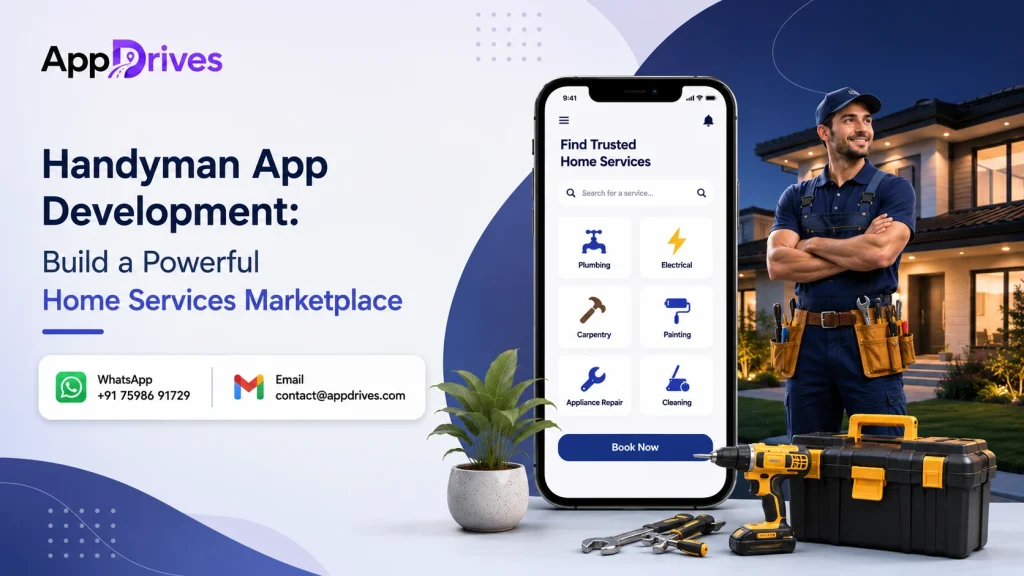
In recent years, the home services industry has changed rapidly. Now customers no longer have to spend hours looking for a more reliable service provider. Rather, they get the service in minutes with the help of their smartphones. This increasing demand has opened opportunities for businesses to create digital platforms. According to the Future Market Insights, the handyman service is expected to grow at 16% by the end of 2035. Therefore, it is the right time to start your handyman business, as these platforms facilitate service booking and management for providers.
Modern handyman apps integrate GPS tracking, secure payment methods, and real-time scheduling to provide a customer, service providers, and administrators with a seamless experience. With the increasing consumer demand for home services on-demand, investing in an on-demand, rich-featured marketplace is a wise business investment for long-term growth.
In this guide, you will come to know everything related to handyman app development.
Let’s Get In to Know More!
What Is Handyman App Development? A Complete Overview
Handyman App development means building mobile and web applications that connect customers with verified home service professionals via a digital marketplace. These applications simplify service discovery, booking, scheduling, payment, communication, and job management within one platform.
Unlike traditional service booking methods, handyman marketplace apps automate the complete customer journey. Users can find nearby professionals, check ratings, make payments, and even give reviews. Meanwhile, service providers get requests for service, determine their availability, accept jobs, and track their income through their service management application. Businesses implement handyman marketplace platforms to cut down on manual tasks and boost customers’ convenience, as well as to generate scalable revenue streams via commissions, subscriptions, and even service fees.
Why Handyman App Development Is Transforming the Home Services Industry
Customer requirements are now more geared towards instant solutions provided via digital platforms. Handyman App Development can assist companies to automate their processes, enhance their service quality, optimize operations and scale up in a hassle-free way providing reliable and convenient home services.
Growing Demand for On-Demand Home Services
Consumers look for a speedy solution that is provided by professional and skilled service personnel in order to fix their issues. On-demand handyman apps allow them to get booked, scheduled and serviced conveniently and quickly.
Digital Convenience for Customers
On a mobile application, consumers can perform all tasks like searching for services, comparing providers, booking appointments, tracking technicians, and making payments. All the above activities can be performed through a single platform.
Better Service Provider Management
Handyman apps make the process of managing providers easier, which includes onboarding of the service provider, job assignment, managing schedules, earnings tracking and performance tracking.
Expanding Local Service Businesses
Digital platforms help to reach more customers and enable handyman businesses to add new service categories. Scalable technology supports sustainable growth without increasing complexity.
Key Features That Power a Successful Handyman Marketplace App
Every handyman marketplace has different business goals and essential features to ensure the platform runs smoothly and supports long-term business growth.
Customer App Features
The customer application focuses on making home service booking simple, fast, and convenient. These features help users discover services, schedule appointments, track professionals, and complete secure payments effortlessly.
Real-Time Booking & Scheduling
Customers can explore all available services, select the best professionals among them, and pick the most suitable appointment time. Then make the booking right away, either instantly or at the appointed date.
GPS Tracking of Service Provider
Live GPS tracking enables customers to check the location of technicians, see the estimated time of arrival and get information updates. It increases transparency, eliminates uncertainties and adds more trust to customers.
Ratings & Reviews
Customers get the option to rate and review the completed services. These reviews help improve service quality and build accountability among professionals. It further helps to guide new customers in choosing trusted professionals.
Multiple Payment Options
Various payment methods such as credit cards, debit cards, digital wallets, UPI, net banking, and cash payments give customers flexibility while ensuring secure and convenient transactions for completed services.
Service Provider App Features
The service provider app enables users to perform daily tasks effectively. The app helps professionals to streamline the process of accepting jobs, scheduling, managing earnings, and performance analysis to enhance productivity and service delivery.
Accept / Reject Job Requests
Professionals get booking requests instantly, and it is possible to accept or reject any job offer according to one’s schedule. Such an option enables to optimize the schedule and avoids extra tasks.
Service Scheduling & Calendar Management:
The integrated calendar feature allows
- Organizing
- Monitoring appointments
- Managing availability
- Avoiding double bookings
- Getting notifications
Effective scheduling helps to be more productive and serve clients promptly.
Earnings Tracking & Wallet:
Professionals get the chance to keep track of their completed jobs, commissions, pending payments, and balance on the dashboard provided by the app. Financial information makes it easier for users to manage their earnings.
Performance Analytics & Reports:
Detailed analytics show information about completed jobs, customer ratings, earnings trends, and response times. These insights help providers improve performance, increase customer satisfaction, and grow their business efficiently.
Admin Panel Features
The admin panel acts as the control center for the marketplace. This tool makes it possible to control users, service providers, bookings, commission structure, and overall performance of the marketplace from a single dashboard.
User Management (Customers)
Administrators have a way to manage user accounts, check their details, oversee booking processes, settle disputes, and respond to user queries from a dashboard that facilitates smooth operation of the marketplace.
Service Provider Management
This tool allows the verification of providers, approval of documents and services offered, monitoring of available services, and performance of service providers.
Role-Based Admin Access
This ensures that different roles on the platform can access only what they need. This is helpful in making sure that data is safe and operational duties are simplified.
Commission Management
Businesses get to determine the commissions, automation of calculation of commissions, generation of payment reports, and analysis of commission revenue from each booking.
Cancellation Handling
This involves handling cancellation of booking on either side, customers and providers by applying policies, giving refunds, and rescheduling where possible.
Real-Time Platform Monitoring
This tool helps the administrator to monitor all activities such as bookings, provider performance, customer inquiries, transactions, and other performance issues.
Smart Features for Better Customer Experience
Intelligent technologies boost user interaction with personalized experiences, communication, and automation of interactions. All this results in increased customer satisfaction and assists businesses with retention and process improvement.
AI-Powered Recommendations
The artificial intelligence system analyses customer preferences, booking records, and customer location in order to suggest appropriate services and specialists. Thus, it helps to improve discovery and conversions and provides a personalized user experience.
Push Notifications
Immediate push notifications keep customers up-to-date regarding booking confirmation, professional arrival, payment updates, promotions, and service reminders. They help to improve the process of communication and reduce the number of no-shows.
Multi-Language Support
The support of multiple languages lets customers and service providers of different regions use the application easily. This feature increases the application audience and improves user experience.
In-App Chat / Messaging
Built-in messaging enables customers and professionals to discuss job requirements, share updates, clarify service details, and resolve questions quickly without leaving the application.
Personalized Service Reminders
Automated reminders are sent to customers regarding their appointments, maintenance, and seasonal services based on previous bookings. This increases repeat business, therefore helping customers to maintain their homes regularly.
How a Handyman Marketplace App Works
The handyman marketplace application provides an easy way for customers to connect with certified service providers using a single online portal. The whole process, from booking services to paying money, everything is done using this application. Here is the complete workflow of on-demand handyman marketplace apps.
Step 1: Customer Signs Up and Chooses a Service
The customer creates an account using their email address, phone number or social network logins. Then they view the list of possible handyman services (plumbing, electrical work, painting, appliance repair, cleaning, and others) and choose the service that is needed.
Step 2: Service Details and Booking
The customer adds the address where the job should be done, selects the date and time, provides additional details about the job, and optionally attaches images. The application calculates the approximate cost of the job and confirms the booking request.
Step 3: Job Matching and Provider Assignment
Depending on the location of the customer, type of service, provider’s availability, rating, and level of experience, the system automatically assigns the request to the most appropriate handyman. In some marketplaces, there could be several providers who would accept the request.
Step 4: Booking Confirmation
When a handyman accepts the request, the client gets a confirmation along with the handyman’s profile, time estimate for reaching there, contact numbers, and booking details.
Step 5: Live Tracking and Service Delivery
The client has a live tracking facility to know where the handyman is moving towards their place. The service is provided by the service provider to complete the requested work, and communication happens via app chatting facility or calling if required.
Step 6: Secure Payment
After delivering the requested service, the client makes payments using whichever mode of payment he wants, like credit or debit card, wallet, UPI, net banking, or even cash.
Step 7: Ratings and Reviews
The client rates the handyman based on their services and writes a review about the service received. The ratings ensure quality of service and increase trust among other benefits for future customers.
Step 8: Admin Monitoring and Business Management
The admin dashboard oversees the entire marketplace by managing users, service providers, bookings, payments, commissions, disputes, promotions, and performance analytics. This allows the business to scale operations while ensuring smooth platform management.
Popular Home Services You Can Offer Through a Handyman App
A handyman marketplace app supports many services, allowing customers to book trusted professionals from a single platform. The app offers multiple services and helps to attract more users, increase bookings, and create additional revenue opportunities. Here are some of the services listed that can be integrated into the application.
- Plumbing
- Electrical Services
- Home Cleaning
- Painting
- Appliance Repair
- Carpentry
- Pest Control
- Gardening & Landscaping
- AC & HVAC Services
- Home Maintenance
Choosing the Right Business Model for Your Handyman App
Choosing the best business model is probably one of the most crucial steps when developing an app for the handyman marketplace. It determines how your app will make money and manage the service providers.
Single Service Business:
A single-service business is aimed at offering only one particular category of services. These could be services like plumbing, electrical work, cleaning services, and appliance repair. It suits well for companies aiming to specialize in one field, gaining a reputation and providing high-quality service in one area.
Multi-Service Marketplace
The multi-service marketplace offers several home services on one platform. Users are able to order various services via the same app. The multi-service model has a large number of potential users and many income sources via commissions or service fees.
Aggregator Model
It allows integrating with independent service providers rather than employing them. The app acts as an intermediary between customers and verified specialists, booking orders and receiving payments. Income is generated through commissions or listing fees.
Franchise Model
A franchise-based handyman app allows local business owners or regional operators to manage services within their territories while following your brand standards. The central platform provides the technology, branding, and operational support while franchise partners handle local service delivery. This model is suitable for businesses planning rapid expansion across multiple cities or regions.
Subscription-Based Marketplace
Instead of relying only on commissions, this model generates recurring revenue by offering subscription plans to service providers. Subscribers may receive benefits such as lower commission rates, higher search visibility, lead access, premium listing, or advanced business tools. It creates a predictable revenue stream while encouraging long-term provider engagement.
Choosing the right business model impacts handyman app development cost.
Handyman App Development Process: From Idea to Launch
Creating a handyman app involves more than just the coding itself. The development process is a key aspect of building a secure, user-friendly, and scalable platform that will provide a great experience right from the first day of launch.
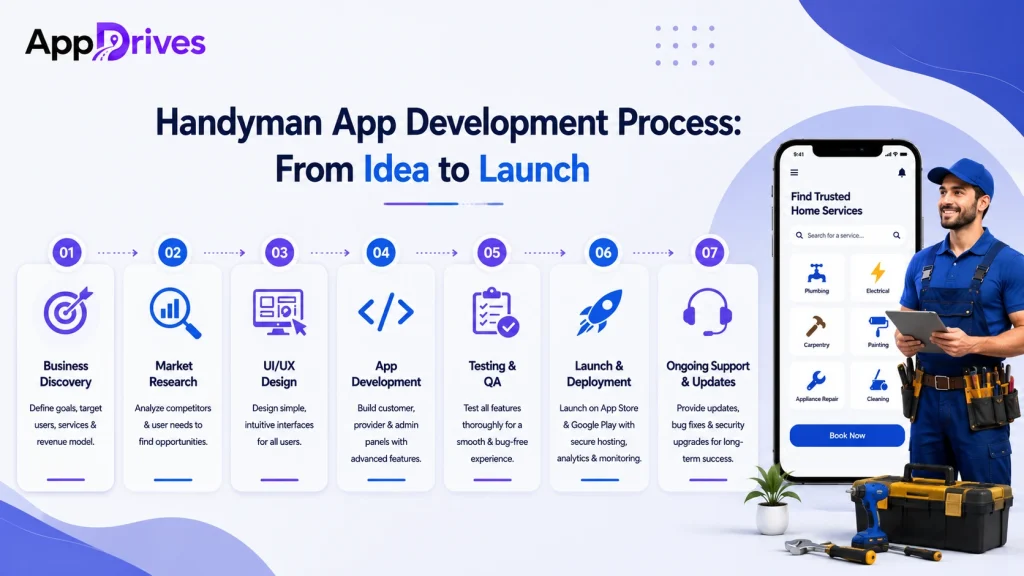
Business Discovery:
First, establish your business objectives, target users, services, and financial model. This step helps to set a trajectory and prevent expensive changes in development.
Market Research:
At AppDrives, we conduct a comprehensive competitor analysis and find what customers want. Market research aids in finding opportunities, adding desirable features and developing something innovative.
UI/UX Design:
We create easy-to-use screens for customers, service providers and admins. Having a clean interface speeds up service booking and enhances the user experience.
App Development:
Our team develop customer, provider, admin dashboards, GPS tracking, and more. We focus on speed, security, and scalability.
Testing & Quality Assurance:
We test all features, identify and resolve problems prior to launch. This will ensure smooth operation, safeguard user information, and provide a consistent user experience across devices.
Launch & Deployment:
Once testing phase is completed, we release the app on the App Store and/or Google Play. Enable cloud hosting, security, analytics, and monitoring services to ensure a seamless and successful launch.
Ongoing Support & Updates:
Update your App to get new features, bug fixes and security upgrades. Frequent upkeep enhances performance, ensures client satisfaction, and promotes sustainability.
Technologies Used in Handyman App Development
Here are the latest tech stacks our developers use to build an user friendly handyman application
| Technology Category | Technologies |
| Mobile App Development | Flutter, React Native, Swift, Kotlin |
| Frontend Development | React.js, Vue.js, Angular |
| Backend Development | Node.js, Laravel, Python, Express.js |
| Database | PostgreSQL, MySQL, MongoDB |
| Cloud & Hosting | AWS, Google Cloud Platform (GCP), Microsoft Azure |
| Maps & Location Services | Google Maps API, Mapbox |
| Payment Gateway | Stripe, PayPal, Razorpay |
| Authentication | Firebase Authentication, OAuth, JWT |
| Push Notifications | Firebase Cloud Messaging (FCM), OneSignal |
| Communication | Twilio, SendGrid |
| Analytics | Google Analytics, Firebase Analytics |
| AI & Machine Learning | OpenAI, TensorFlow, ML Kit |
| DevOps & CI/CD | Docker, Kubernetes, GitHub Actions, Jenkins |
| Version Control | Git, GitHub, GitLab, Bitbucket |
Common Challenges in Handyman App Development and How to Solve Them
Building a handyman marketplace app is only the first step. Running and growing the platform comes with several operational challenges, from managing service providers to maintaining customer satisfaction. Addressing these challenges early helps you build a reliable handyman marketplace management system and a scalable handyman business software solution.
Managing Service Provider Availability
Keeping service providers available during peak hours can be difficult. Real-time scheduling, automated job assignments, and calendar management help reduce booking conflicts and improve service availability.
Handling Multiple Service Categories
As your platform grows, managing different services becomes more complex. A well-structured category management system makes it easy to organize services, pricing, and provider skills.
Maintaining Service Quality
Consistent service quality is essential for customer trust. Provider verification, customer ratings, reviews, and regular performance monitoring help maintain high service standards across the platform.
Payment Security
Customers expect safe and secure transactions. Integrating trusted payment gateways, data encryption, fraud detection, and secure authentication protects both customers and service providers.
Customer Retention
Acquiring customers is important, but keeping them is even more valuable. Loyalty programs, personalized offers, push notifications, and excellent customer support encourage repeat bookings and long-term engagement.
Platform Scalability
As bookings and users increase, your platform should continue to perform smoothly. A scalable cloud infrastructure, optimized database, and efficient backend architecture ensure your handyman marketplace can grow without affecting performance.
Why Choose AppDrives for Handyman App Development?
Your vision deserves more than a development partner; it deserves a team invested in your success. AppDrives, the leading on-demand mobile app development company, we don’t just build handyman apps; we create digital marketplaces designed to help businesses launch faster, operate smarter, and scale confidently. Every solution is tailored to your business model, whether it’s a single-service platform or a multi-service marketplace. With clean code, robust security, seamless integrations, and continuous support, we ensure your platform is ready for real-world growth. As your business evolves, your app evolves with it, making AppDrives a technology partner committed to your long-term success, not just your product launch.
Frequently Asked Questions
Q1. What is Handyman App Development?
Handyman app development is the process of creating a mobile or web application that connects customers with service professionals for booking, payments, scheduling, tracking, and marketplace management.
Q2. How does a handyman marketplace app work?
Customers choose a service, book an appointment, and make payments through the app. Service providers accept requests, complete jobs, and receive earnings while admins manage the platform.
Q3. What features should a handyman app include?
A handyman app should include user registration, service booking, scheduling, GPS tracking, secure payments, push notifications, ratings, reviews, chat, provider management, and an admin dashboard.
Q4. How long does handyman app development take?
A basic handyman app usually takes 8–12 weeks, while a feature-rich custom marketplace with advanced integrations and AI capabilities may require 4–6 months to develop.
Q5. Which technologies are used in handyman app development?
Popular technologies include Flutter, React Native, Swift, Kotlin, Node.js, Laravel, PostgreSQL, Firebase, Google Maps API, AWS, Stripe, and AI tools for automation and personalization.
Q6. Can AI be integrated into a handyman app?
Yes. AI can power smart job matching, predictive pricing, automated scheduling, customer support chatbots, personalized recommendations, fraud detection, and demand forecasting to improve operational efficiency.
Q7. How do handyman apps generate revenue?
Handyman apps generate revenue through booking commissions, subscription plans, featured listings, service fees, advertising, franchise partnerships, premium memberships, and value-added business services.
Q8. How do I choose the right Handyman App Development Company?
Choose a company with marketplace development experience, strong technical expertise, customizable solutions, transparent pricing, security-focused development, positive client reviews, and reliable post-launch support.